
Top Secure USB Drive Features You Should Look for Before Buying

1. Why Evaluating a Secure USB Drive Matters for Wholesale Buyers
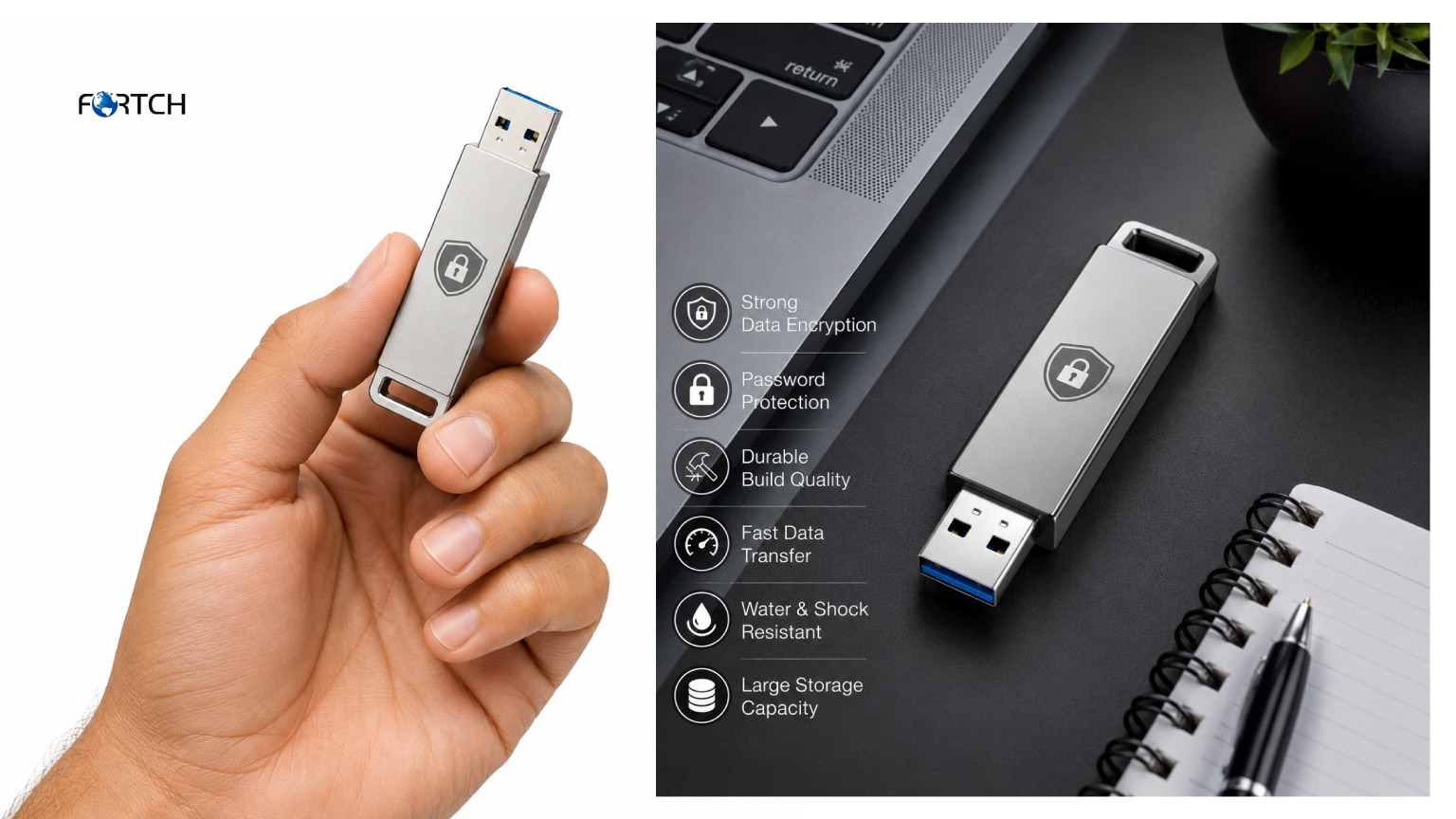
The process of selecting a secure USB drive extends far beyond basic storage capacity, particularly for B2B buyers procuring items at scale. Modern enterprises require portable storage solutions that actively protect sensitive corporate data against escalating cyber threats. Evaluating the specific security features of a secure flash drive ensures that the final product aligns with stringent organizational compliance mandates. Wholesale buyers bear the responsibility of vetting these features meticulously before committing to large-scale distribution.
The necessity for rigorous evaluation stems from the dramatic shift in how global workforces handle digital assets. Remote and hybrid operational models have made physical data transport significantly more vulnerable to interception and loss. This reality directly impacts wholesale buyers by elevating the potential liability associated with distributing standard, unsecured promotional drives. Selecting a fully verified secure USB drive mitigates the risk of catastrophic data breaches that could severely damage a brand’s reputation.
Organizations must respond to these vulnerabilities by treating portable storage as a critical piece of enterprise cybersecurity infrastructure. Procurement teams are shifting their budgets away from cheap, disposable memory sticks toward premium, hardware-encrypted solutions. A high-quality encrypted USB drive functions as a tangible extension of a company’s overall IT security policy. This strategic pivot transforms a simple giveaway into a highly valuable corporate asset.
For wholesale distributors, emphasizing security features during the sales process creates a distinct competitive advantage in a crowded market. Sourcing a secure flash drive from a manufacturer capable of consistently meeting high cryptographic standards guarantees long-term client satisfaction. Bulk buyers who prioritize these protective elements ultimately secure stronger, more lucrative contracts with enterprise clients who demand uncompromising data safety.
1.1. Which Physical Durability Elements Protect Your Encrypted USB Drive Investment
Hardware resilience serves as the foundational layer of defense for any portable storage device deployed in demanding corporate environments. A secure USB drive routinely exposed to field operations, industrial sites, or constant travel must withstand significant physical abuse. The external casing acts as the primary shield, protecting the delicate internal cryptographic processors and memory chips from environmental hazards. Wholesale buyers must prioritize ruggedized designs to ensure the longevity of their bulk orders.
The demand for durable hardware has surged because mobile workforces are inherently rougher on their equipment than stationary office workers. Drops, liquid spills, and extreme temperatures are common occurrences that can instantly destroy standard flash media. This directly affects procurement strategies by forcing buyers to seek out specialized secure flash drive models engineered for extreme conditions. Failing to account for physical durability leads to high replacement rates and rapid data loss.
Buyers should combat these environmental threats by specifying exact manufacturing standards during the custom ordering process. Requesting secure USB drive units with an IP68 rating guarantees complete protection against dust ingress and prolonged water submersion. Furthermore, specifying industrial-grade epoxy potting for the internal circuit board prevents vibration damage and secures the encrypted USB drive against physical tampering.
Wholesale purchasers benefit immensely from offering physically robust customized drives to their B2B client base. A ruggedized secure flash drive communicates a message of premium quality and industrial reliability. By partnering with manufacturers who utilize aerospace-grade plastics or lightweight aluminum alloys, distributors can deliver a secure USB drive that survives years of heavy daily utilization.
1.2. How NAND Flash Quality Influences Secure USB Drive Longevity
The internal memory architecture of a portable storage device dictates its operational lifespan and overall reliability. Not all flash memory is manufactured equally, and the grade of the NAND chips directly impacts how long data remains accessible. A premium secure USB drive relies on high-tier memory silicon to prevent premature degradation and sudden data corruption. Wholesale buyers must look beyond the advertised storage capacity and scrutinize the specific memory components utilized by the factory.
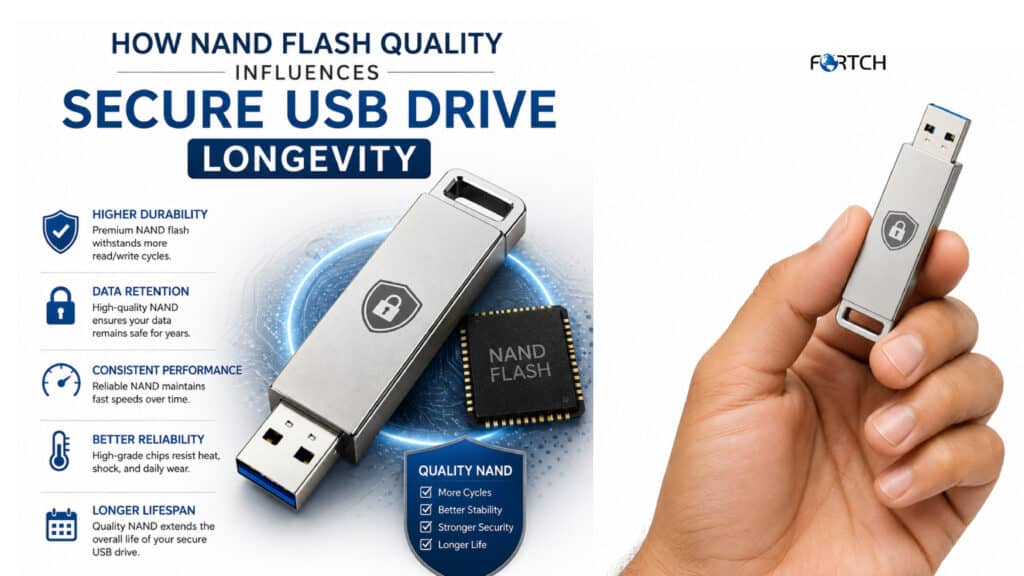
The reason memory quality has become a critical focal point is the increasing prevalence of low-cost, recycled, or downgraded flash chips in the global supply chain. These substandard components degrade rapidly after a few hundred write cycles, completely defeating the purpose of investing in a secure flash drive. This reality heavily impacts bulk buyers, as a batch of failing drives will inevitably result in frustrated clients, massive return rates, and destroyed brand trust.
Procurement professionals must respond to this supply chain risk by explicitly mandating Tier 1 MLC (Multi-Level Cell) or high-endurance TLC (Triple-Level Cell) NAND in their purchase orders. Avoiding cheaper eMMC or QLC alternatives ensures that the encrypted USB drive can handle the heavy read/write demands of enterprise users. Reputable wholesale suppliers will provide written guarantees regarding the authenticity and grade of the memory chips used in their secure USB drive production lines.
Offering enterprise-grade memory configurations allows B2B distributors to position their customized products as true enterprise solutions. When a client orders a secure flash drive for critical backup protocols, the assurance of long-lasting NAND flash provides immense peace of mind. This attention to internal hardware quality differentiates a premium wholesale offering from a commodity promotional item.
2. How Encryption Standards Impact Your Custom Encrypted USB Drive Orders
Cryptographic security represents the core value proposition of any premium portable storage device. The type of encryption integrated into a secure USB drive determines whether intercepted data remains genuinely private or becomes easily readable by unauthorized parties. Understanding the distinction between software-based password protection and true hardware encryption is crucial for bulk buyers. Custom encrypted USB drive orders must be built upon uncompromising cryptographic foundations to satisfy enterprise IT departments.
The transition toward hardware-based encryption is accelerating because software-based defenses have proven highly vulnerable to sophisticated cyberattacks. Malware can often bypass software passwords or capture keystrokes when a user unlocks a secure flash drive on a compromised host computer. This vulnerability deeply affects wholesale buyers, as distributing a supposedly secure USB drive that is easily hacked exposes the distributor to severe legal and financial liabilities.
To counter these advanced threats, procurement teams must mandate AES 256-bit hardware encryption for all bulk orders. This level of cryptographic protection processes the data scrambling directly on a dedicated chip within the encrypted USB drive, entirely independent of the host operating system. Buyers should additionally require that the secure USB drive holds FIPS 140-2 Level 3 (or Level 4) validation, proving that the cryptographic module has been rigorously tested by independent government laboratories.
Integrating these high-level encryption standards requires close collaboration between the wholesale buyer and the manufacturing facility. The factory must possess the technical expertise to pre-load cryptographic keys and configure the secure flash drive precisely to the buyer’s specifications. By offering FIPS-validated, hardware-encrypted solutions, B2B distributors can successfully penetrate highly regulated industries such as defense, healthcare, and finance.
2.1. Which Encryption Protocols Should You Mandate for a Secure USB Drive
Selecting the correct cryptographic protocol is the most technical and vital decision in the procurement process. The Advanced Encryption Standard (AES) remains the undisputed benchmark for securing digital data at rest. A secure USB drive utilizing AES 256-bit encryption provides a mathematical certainty that data cannot be brute-forced by current or foreseeable computing technology. Wholesale buyers must ensure this specific protocol is hardwired into the controller of every secure flash drive they source.
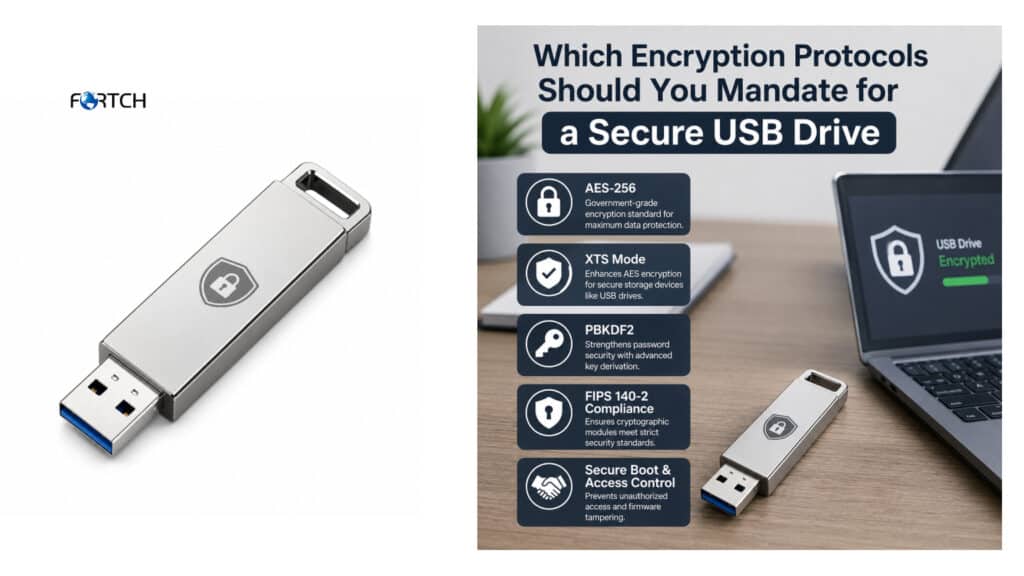
The dominance of AES stems from its universal recognition by global cybersecurity frameworks and government agencies. Using an unproven or proprietary encryption algorithm on an encrypted USB drive creates unnecessary compliance hurdles for end-users. This directly impacts B2B buyers because enterprise IT departments will immediately reject any portable storage that does not adhere to AES standards. Stocking non-compliant drives effectively shrinks the potential customer base to zero.
Buyers must respond by demanding comprehensive documentation from the manufacturer confirming the implementation of XTS-AES block cipher modes. This specific mode is optimized for storage devices, preventing certain types of cryptographic attacks that target smaller blocks of data. Furthermore, the secure USB drive must feature a random number generator that meets strict NIST standards to create unguessable encryption keys for every single unit produced.
Providing AES 256-bit hardware encryption as a standard feature elevates the perceived value of any wholesale catalog. When a distributor can confidently state that their customized secure flash drive meets the exact same cryptographic standards used by military intelligence agencies, it closes high-value B2B sales. This protocol compliance transforms a simple storage accessory into an indispensable enterprise security tool.
2.2. How User Authentication Mechanisms Strengthen Encrypted USB Drive Security
Encryption algorithms are useless without robust, user-friendly methods for unlocking the protected data. The authentication mechanism dictates how an authorized user gains access to the secure USB drive while keeping malicious actors out. Modern secure flash drive models have evolved far beyond basic text passwords, incorporating advanced physical and biological verification methods. Wholesale buyers must evaluate these access controls to ensure the encrypted USB drive balances maximum security with practical usability.
The industry is rapidly moving away from software-based PIN entry because of the rampant rise of keylogging malware and phishing attacks. If a user enters their password on a compromised computer, the security of the secure USB drive is instantly compromised. This shift significantly impacts buyers, as outdated authentication methods render the expensive hardware encryption completely ineffective. Clients are actively demanding physical authentication solutions that bypass the host keyboard entirely.
Procurement strategies must adapt by prioritizing secure USB drive models equipped with built-in alphanumeric keypads or capacitive touch interfaces. For the highest tier of security, buyers should consider a biometric secure flash drive that utilizes an onboard fingerprint scanner. These hardware-based authentication methods ensure that the user’s credentials never interact with the host PC, creating a completely isolated security environment.
Offering a variety of authentication options allows wholesale distributors to cater to diverse corporate preferences and budget levels. A custom encrypted USB drive with a sleek, integrated keypad appeals to financial institutions, while a biometric model attracts high-tech enterprises. By supplying advanced access controls, B2B buyers provide their clients with the exact tools needed to enforce strict endpoint security policies.
3. Which Customization Options Align with Your Secure Flash Drive Strategy
Customization transforms a generic piece of technology into a powerful ambassador for a corporate brand. For a secure USB drive, the customization process must enhance the aesthetic appeal without interfering with the sensitive internal antennas, keypads, or encryption chips. Strategic branding turns a standard secure flash drive into a highly coveted corporate gift or an authoritative internal company asset. Wholesale buyers must navigate the customization process carefully to maintain both visual impact and hardware integrity.
The emphasis on premium branding has grown because a poorly branded product reflects negatively on the perceived quality of the security technology itself. A cheaply attached paper label or easily scratched paint job suggests that the encrypted USB drive inside is equally inferior. This psychological effect heavily impacts B2B purchasers, as high-level executives and IT directors will judge the reliability of the secure USB drive by its exterior build quality.
Businesses must respond to this by investing in permanent, high-resolution customization techniques during the manufacturing phase. Laser engraving is the preferred method for a metal secure flash drive, as it physically etches the logo into the casing without risking damage to the internal components. For plastic models, UV flatbed printing offers a durable, tactile finish that resists fading and scratching, ensuring the secure USB drive maintains its professional appearance for years.
Wholesale distributors who offer sophisticated, factory-level branding capabilities can command significantly higher profit margins on their bulk orders. Presenting a client with a flawlessly customized encrypted USB drive demonstrates a level of professionalism that separates premium suppliers from commodity vendors. This attention to aesthetic detail ultimately drives repeat business and solidifies long-term B2B partnerships.
3.1. How Branding and Logo Integration Enhance Secure USB Drive Value
Effective logo integration requires a deep understanding of materials, print technologies, and industrial design. The surface area on a modern secure USB drive is often limited by the necessity of housing keypads, fingerprint scanners, or LED indicators. Strategic logo placement ensures that the brand identity remains highly visible on the secure flash drive without obstructing any functional elements. Wholesale buyers must work closely with design engineers to achieve this delicate balance.
The value of intelligent logo placement stems from the need to maximize brand exposure in competitive corporate environments. A logo hidden on the back or side of an encrypted USB drive fails to generate the marketing ROI expected from a custom bulk order. This impacts buyers by forcing them to reject generic factory designs that do not optimize the visible real estate. Clients expect their customized secure USB drive to serve as a prominent, daily reminder of their brand.
Buyers should resolve this by requesting factory-specific 2D and 3D digital mockups prior to production. These renderings allow the procurement team to evaluate exactly how the logo will interact with the curves, textures, and security interfaces of the secure flash drive. Furthermore, utilizing dual-tone laser engraving or full-color UV printing can add subtle premium accents, such as matching the encrypted USB drive trim to the client’s corporate Pantone colors.
Executing flawless logo integration on a bulk scale requires a manufacturing partner with rigorous quality control protocols. Wholesale buyers should insist on physical pre-production samples of the secure USB drive to verify the color accuracy and durability of the branding. Delivering a perfectly branded secure flash drive ensures that the end-client views the bulk purchase as a high-value investment rather than a generic procurement expense.
3.2. Which Pre-Loading and Autoplay Features Maximize Encrypted USB Drive Utility
A customized portable storage device offers immense potential as a dynamic platform for digital corporate communications. Pre-loading data onto a secure USB drive allows organizations to distribute catalogs, security software, or training materials directly alongside their branding. The secure flash drive becomes a complete, self-contained multimedia package the moment it is unplugged from the factory assembly line. Wholesale buyers can leverage these digital services to significantly increase the perceived value of their bulk orders.
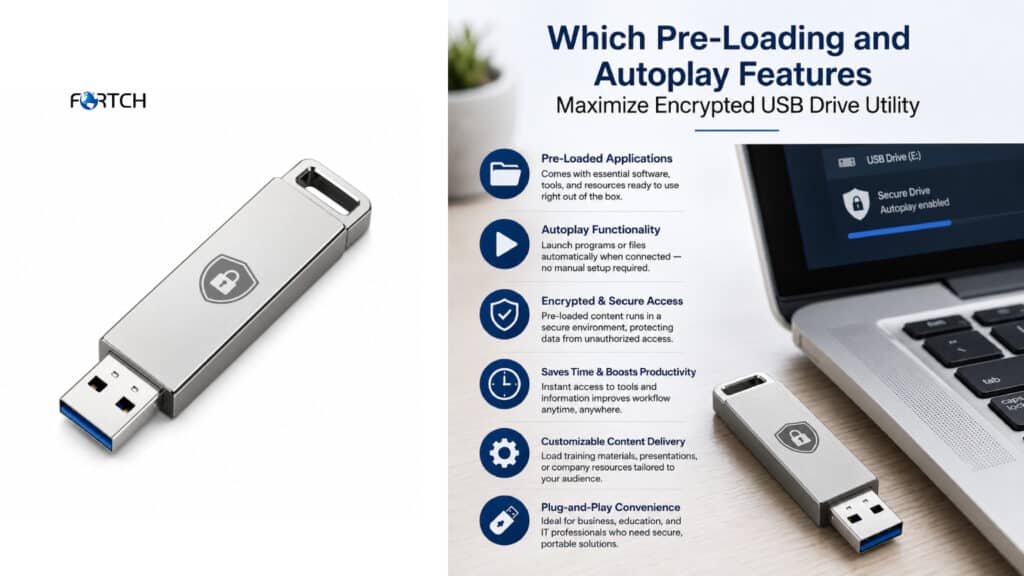
The demand for pre-loaded content is surging because B2B clients are constantly seeking ways to reduce their own operational friction. Manually loading sensitive training documents onto thousands of individual encrypted USB drives is a massive waste of IT resources. This affects wholesale buyers by creating an opportunity to offer a managed, turnkey solution. Supplying a secure USB drive that is already populated with the client’s proprietary data provides immense convenience.
To capitalize on this trend, buyers must establish clear data handling protocols with their manufacturing partners. The factory must possess secure, air-gapped systems for receiving and duplicating the client’s data onto the secure flash drive to prevent any accidental leaks. Additionally, the encrypted USB drive can be configured with a custom autoplay interface that launches a branded welcome screen or interactive menu immediately after the user enters their correct PIN or fingerprint.
Offering pre-loading and custom autoplay services transforms the wholesale supplier into a comprehensive technology partner. By managing the digital content as well as the hardware customization of the encrypted USB drive, distributors can lock out competitors who only offer blank storage. This end-to-end service capability maximizes the utility of every secure USB drive shipped, driving higher B2B sales volumes.
4. How 2025 Data Breach Statistics Shape the 2026 Secure USB Market
The cybersecurity landscape of 2025 has fundamentally altered the perceived value of offline, portable data storage. Recent industry analyses reveal that network-based ransomware attacks have increased by over sixty percent in 2025, targeting cloud backups and network-attached storage with unprecedented sophistication. This alarming trend has resurrected the secure USB drive as a vital tool for “air-gapped” data isolation. Wholesale buyers must understand these current statistics to accurately forecast their inventory needs for the upcoming year.
The reason air-gapping has become a mainstream corporate strategy is the relentless success of automated phishing and zero-day exploits against connected networks. When a network is compromised, any storage device connected to it is also compromised. This reality drastically affects buyers by shifting the demand away from basic promotional flash drives toward heavily fortified secure flash drive models. Enterprise clients are now actively seeking offline repositories to protect their most critical intellectual property.
Organizations are responding to the 2025 breach statistics by mandating that all sensitive data transfers occur via isolated hardware. Procuring a FIPS-validated encrypted USB drive allows IT departments to physically disconnect their most valuable data from the vulnerable corporate network. This tactical shift requires wholesale distributors to rapidly adjust their product catalogs, moving away from consumer-grade storage and focusing exclusively on enterprise-class secure USB drive solutions.
The momentum generated by these 2025 cybersecurity crises is setting the stage for a massive market expansion in 2026. Wholesale buyers who align their purchasing strategies with these air-gapping protocols will capture a dominant share of next year’s B2B technology budgets. Positioning the secure flash drive as an essential ransomware defense mechanism is the most effective sales strategy for the modern era.
4.1. Why 2025 Ransomware Trends Are Driving Secure USB Drive Adoption
The specific mechanics of 2025 ransomware operations have rendered traditional cloud-based disaster recovery plans highly unreliable. Modern threat actors now specifically target backup servers, encrypting both the primary data and the secondary cloud backups simultaneously. This devastating tactic has forced CISOs (Chief Information Security Officers) to re-evaluate their reliance on connected infrastructure, sparking a massive surge in secure USB drive deployments. Wholesale buyers are seeing a sudden, urgent spike in purchase orders from the enterprise sector.
This trend is happening because the encryption algorithms utilized by ransomware syndicates have become highly efficient, capable of paralyzing a global enterprise in minutes. The realization that cloud backups can be held hostage alongside primary servers has created a state of panic among IT leadership. This impacts wholesale buyers by shortening the traditional B2B sales cycle; clients no longer have months to deliberate, they need a secure flash drive solution immediately to facilitate offline backups.
The appropriate response for wholesale distributors is to aggressively market the concept of the “immutable backup” using hardware-encrypted storage. A secure USB drive that requires physical authentication and operates entirely offline cannot be encrypted by remote ransomware. Buyers should educate their clients that keeping an encrypted USB drive locked in a physical safe provides a level of data assurance that no cloud provider can match.
Capitalizing on this ransomware panic requires wholesale suppliers to maintain deep inventory of high-capacity, fast-transfer secure flash drive models. By understanding the specific pain points caused by 2025 ransomware attacks, B2B buyers can position themselves as consultative security partners rather than simple hardware vendors. This strategic positioning drives high-volume sales of the secure USB drive as a critical piece of disaster recovery infrastructure.
4.2. Which 2026 Market Projections Should Guide Your Encrypted USB Drive Inventory
Forward-looking procurement strategies must account for the rapid technological advancements expected to mature in 2026. Industry analysts project that by 2026, the average corporate data packet size will have doubled, driven by the widespread integration of 4K video, complex CAD files, and expansive datasets. This projection indicates that standard USB 2.0 or small-capacity models will face total market obsolescence. Wholesale buyers must curate their encrypted USB drive inventory to meet these impending performance benchmarks.
The shift toward larger data payloads is happening simultaneously with the global transition toward faster data transfer protocols. The older USB 3.0 standard is rapidly being replaced by USB 3.2 Gen 1 and Gen 2 interfaces across all commercial laptops and workstations. This directly impacts wholesale buyers because stocking outdated interface technology will result in severe bottlenecks for end-users attempting to transfer massive files to their secure flash drive. Clients will quickly abandon suppliers who offer sluggish, obsolete hardware.
Buyers must proactively respond by setting minimum specifications for all future secure USB drive purchase orders. A responsible 2026 inventory strategy mandates a baseline of USB 3.2 speeds and minimum storage capacities of 64GB or 128GB. Furthermore, buyers should verify that the encrypted USB drive controller is optimized to handle high-speed data streaming without throttling the cryptographic processing speed.
Anticipating these 2026 market demands allows wholesale distributors to capture early adopter sales and secure long-term enterprise contracts. Offering a future-proof secure flash drive demonstrates technological competence and protects the buyer’s investment over a multi-year deployment cycle. By aligning inventory with these performance projections, B2B buyers ensure their secure USB drive offerings remain highly relevant and profitable.
5. Why Partnering with the Right Manufacturer Ensures Wholesale Success
The theoretical features of a premium storage device mean very little if the overseas factory lacks the engineering capability to execute them consistently. Selecting the right manufacturing partner is the single most important decision a wholesale buyer will make. A reliable factory ensures that every secure USB drive rolling off the assembly line meets the exact cryptographic, durability, and branding specifications promised to the end-client. This partnership forms the bedrock of a successful B2B distribution business.
The necessity for extreme vetting stems from the complex nature of combining hardware encryption with custom aesthetics in a miniature form factor. Many contract manufacturers excel at basic plastic molding but lack the cleanroom environments and cryptographic expertise required to produce a true secure flash drive. This reality drastically affects wholesale buyers, as a single batch of poorly assembled drives can trigger massive product recalls, legal liabilities, and the permanent loss of key enterprise accounts.
Procurement teams must respond by implementing exhaustive factory audit protocols before placing any bulk orders. Verifying ISO 9001 quality management systems and FIPS laboratory certifications is an absolute minimum requirement. Buyers should demand traceability reports proving that the secure USB drive components, particularly the encryption microchips, are sourced directly from authorized, tier-one silicon vendors rather than the gray market.
Establishing a deep, collaborative relationship with a certified manufacturer provides wholesale buyers with a sustainable competitive advantage. A top-tier factory will assist in designing custom secure flash drive molds, optimizing the assembly line for rapid turnaround times, and troubleshooting complex technical issues. This level of partnership ensures a steady, reliable supply of high-quality encrypted USB drive units capable of satisfying the most demanding B2B clients.
5.1. How Factory Certifications Guarantee Secure USB Drive Quality
Third-party certifications serve as the only objective metric for evaluating a factory’s ability to produce complex security hardware. When a facility holds specific certifications for producing a secure USB drive, it proves that their manufacturing processes have been independently audited and validated. These certifications act as a shield for wholesale buyers, protecting them from the catastrophic consequences of supplying substandard or counterfeit secure flash drive products to corporate clients.
The reason certifications carry such immense weight is the inherent difficulty in reverse-engineering cryptographic hardware to verify its authenticity after production. A fake or poorly implemented encrypted USB drive may look identical to a premium model but contain fatal security flaws. This deeply impacts buyers because distributing a non-compliant device into a regulated environment can result in heavy government fines for the end-user, liability for which the distributor will ultimately be held responsible.
Buyers must insist on reviewing the factory’s FIPS 140-2/140-3 validation certificates directly from the testing laboratory, rather than relying on marketing materials. For general manufacturing quality, ISO 9001 and ISO 14001 certifications confirm that the secure USB drive is produced in a controlled, environmentally responsible facility. Additionally, RoHS and REACH compliance guarantees that the secure flash drive is free from hazardous materials, facilitating global shipping and corporate compliance.
Leveraging a factory’s certifications in B2B marketing materials significantly shortens the enterprise sales cycle. When a wholesale distributor can provide a prospective client with a valid FIPS certificate for their custom encrypted USB drive, it bypasses months of internal IT security reviews. These certifications serve as the ultimate proof of quality, transforming a secure USB drive from a proposed concept into an approved, purchasable solution.
5.2. Which Flexible MOQ and Support Structures Benefit Secure Flash Drive Buyers
The financial dynamics of B2B technology distribution require a delicate balance between bulk pricing and inventory management. Minimum Order Quantities (MOQs) dictate how much capital a wholesale buyer must tie up in physical inventory before a single unit is sold. Securing favorable MOQ terms for a secure USB drive allows distributors to offer highly customized solutions without bearing excessive financial risk. Flexible support structures from the manufacturer are just as critical as the physical product itself.
The demand for flexible MOQs is rising because corporate budgets are increasingly segmented into smaller, decentralized departmental allocations. A marketing department might only need five hundred customized secure flash drive units for a specific executive conference, while the IT department needs five thousand for a company-wide rollout. This fragmentation impacts wholesale buyers by forcing them to turn away highly profitable mid-sized orders if their factory enforces rigid, high-volume minimums.
Distributors must respond by partnering with manufacturers who offer tiered MOQ structures based on the level of customization required. A factory that allows lower MOQs for existing secure USB drive molds—while requiring higher MOQs for completely custom tooling—provides the necessary flexibility to win diverse B2B contracts. Furthermore, buyers should negotiate consignment inventory agreements or rapid-fulfillment programs to keep capital fluid.
The level of post-sale support provided by the factory directly influences the end-client’s satisfaction with their encrypted USB drive. A manufacturer that offers dedicated account managers, rapid physical prototyping, and comprehensive warranty replacement services empowers the wholesale buyer. By aligning with a supportive, flexible factory, distributors can confidently sell complex secure flash drive solutions knowing they have a reliable partner backing every transaction.
6. How to Initiate Your Next Bulk Secure USB Drive Project
Transitioning from the evaluation phase to actual production requires a structured, methodical approach to project management. Ordering a custom secure USB drive involves synchronizing hardware specifications, branding assets, and cryptographic configurations into a single manufacturing run. Wholesale buyers must establish a clear onboarding process to ensure their secure flash drive project is executed flawlessly. Initiating the project correctly prevents costly production delays and guarantees that the final product meets all enterprise expectations.
A structured onboarding process is critical because the intersection of physical manufacturing and digital security leaves absolutely no room for ambiguity. A simple miscommunication regarding the color of an LED indicator or the specific algorithm used on the encrypted USB drive can render an entire batch useless. This impacts buyers by highlighting the importance of detailed purchase orders and engineered drawings. Vague requirements inevitably lead to disputes, rework, and missed client delivery deadlines.
Buyers should initiate their projects by compiling a comprehensive specification sheet that outlines every minute detail of the secure flash drive. This document must include memory capacity, interface speed, encryption standard, authentication method, casing material, and exact Pantone color codes for branding. Providing the manufacturer with this level of granular detail at the outset of the secure USB drive project ensures that both parties share an identical vision of the final product.
The final step in initiating a successful bulk order is to require a physical pre-production sample before authorizing full-scale manufacturing. Evaluating this sample allows the wholesale buyer to physically test the encryption functionality, inspect the logo quality, and verify the durability of the secure USB drive. Approving this golden sample locks in the production standards, paving the way for a smooth, high-volume manufacturing run.
To secure the most reliable and professionally customized encrypted USB drive for your B2B clients, it is essential to partner with a manufacturer who understands these intricate requirements. Our production facilities are fully equipped to deliver FIPS-validated, premium hardware tailored to your exact wholesale specifications. Contact our engineering and sales team today to submit your custom secure flash drive specifications, request a rapid prototype, and secure competitive bulk pricing for your upcoming enterprise projects.